The interview was published in: 360 Degrees
Sister Ephimia is part of the large monastic family of the Macedonian Orthodox Church–Ohrid Archbishopric. The monastery in Rajčica is renowned for the handcrafted production of liturgical items and, for more than a decade, of Christmas Nativity caves, which have become a symbol of the celebration of Christmas Eve.
The Nativity of Christ offers us a different kind of answer. It reminds us that God is not an abstract idea at the top of some hierarchy, but a Person who enters into our pain. That is why Christ is needed by all of us — not as a religious symbol, but as oxygen for our society, says Sister Ephimia, a nun from the Rajčica Monastery, who in this Christmas interview speaks about the meaning of the feast as well as the history of its celebration.

Sister Ephimia is part of the large monastic family of the Macedonian Orthodox Church–Ohrid Archbishopric (MOC–OA). The Rajčica Monastery is widely recognized for the handmade production of liturgical objects and, for more than a decade, for Christmas Nativity caves that have become a distinctive symbol of the celebration of Christmas Eve.
“The making of Christmas Nativity caves in our monastery in Rajčica is not a craft endeavor, but a specific form of preaching. Our intention was simple, yet profound: that every home might become a ‘small church.’ The cave is not a decorative object, but an icon that reminds us of the ontological turning point we spoke of earlier — that God chose to dwell in a cave so as to find a place in our heart, in our home. The motivation has never been material; on the contrary, the cave is a symbol of self-giving,”
says Sister Ephimia.
Question: Today marks the celebration of one of the most significant Christian feasts, the Nativity of Christ, or Christmas. What does this day signify for Orthodox Christians, and why is it a day of joy for them?
Sister Ephimia: When we speak of Christmas, we are in fact confronted with the event that represents the greatest ontological asymmetry in the history of existence: the moment when the Incomprehensible and Infinite God willingly confines Himself within the narrow boundaries of human nature. This “disproportion” between divine perfection and human limitation is not an obstacle, but rather the very core of the feast. For Orthodox Christians—and indeed for all humanity—Christmas is not merely a reminiscent reflection of a past historical event, but an existential irruption of Eternity into the very fabric of time.
This irruption leads us to the essence of what Christmas bestows upon the world: a radical ontological revolution. In a world dominated by cold paradigms of power and political sovereignty, Bethlehem reveals a different kind of authority—one that is not proven by force, but by love and service. Through the mystery of His kenosis (self-emptying), God embraces human vulnerability, thereby fundamentally redefining the notion of human dignity: through the Incarnation, the human person ceases to be defined as a biological accident or a social atom and becomes a space of divine presence. And if the Uncreated became human, then every person bears within themselves an infinite value that transcends every social order. Christmas is the feast of restored dignity—a reminder that true power is not exercised through domination over the other, but through existence for the other.
Question: If we look at history, when did this feast begin to be celebrated? What are its historical roots, and why was the date of 25 December chosen?
Sister Ephimia: The history of this feast is a fascinating lesson in how theology ennobles culture. As Metropolitan Hierotheos (Vlachos) observes, the Nativity is the “root” from which all the feasts of the Lord grow. Without this beginning, there would be no Resurrection. It is noteworthy that during the first three centuries, the Nativity of Christ was not celebrated on a specific date. Early Christians, with their profound focus on eternity, placed greater emphasis on spiritual birth (Baptism) and “birth into heaven” (martyrdom) than on the bodily coming into the world.
The turning point came in the fourth century. Until then, Christmas was part of the common feast of Epiphany (Theophany). Its separation and observance on 25 December begins in Rome around the year 354. At that time, Rome celebrated the pagan cult of the “Unconquered Sun” (Sol Invictus). But what did the wise Christians do? Rather than entering into a direct conflict with this cult, they did something far more subtle and powerful: they transformed its symbolism, proclaiming, “You celebrate the physical sun, but we celebrate the Sun of Righteousness—Christ, who gives eternal meaning to existence.”
The Eastern part of the Empire later adopted this practice. The tradition associated with Juvenal, Bishop of Jerusalem, reveals an interesting and pragmatic aspect as well. He sought assistance from the Roman archives to determine the date, having realized that it was physically impossible on the same day to make processions both to Bethlehem (the place of the Nativity) and to the Jordan (the place of the Baptism).
Thus, in the symbiosis of theological depth, historical circumstances, and pastoral wisdom, Christmas was formed as the cornerstone of our calendar. What, then, do we truly celebrate? We celebrate the moment when the Invisible became Visible, when the “True Sun” entered our darkness in order to illumine us. It is the feast of a light that does not overcome darkness by force, but by its very presence.
Question: Christmas, like Easter, is preceded by a period of fasting. These are the longest periods in the year during which believers abstain from rich food and harmful thoughts. Why does fasting exist at all?
Sister Ephimia: Fasting is not merely a dietary discipline or a religious custom. It is an ontological preparation of space. If we look at the manger in Bethlehem, we encounter a striking paradox: He who holds the entire cosmos, who is Incomprehensible, chooses to dwell in the narrowest and most humble of spaces. In this light, we must also understand the purpose of the forty-day journey: our inner “contraction,” the restraint of the ego, in order to create space for the other.
Moreover, in the context of today’s economic polarization and social injustice, fasting should become for us an act of solidarity. When we abstain, we are in fact declaring that our appetite is not the center of the world. Mercy must become our center.
There is, however, another dimension to which I wish to draw attention: during fasting, we also encounter the tragic Herodian complex that continues to haunt humanity to this day. Why was Herod afraid of a newborn child? Because his power was founded on exclusivity, whereas Christ’s is founded on inclusivity. Herod is a symbol of every totalitarian mindset—political or spiritual—that believes it must extinguish the light of the other in order to shine. This is the dark metaphor of domination: to destroy in order to possess, to divide in order to rule. Christmas confronts us with this contradiction and overturns this logic, replacing the exclusivity of power with inclusivity and the principle of love.
Thus, the true aim of fasting is to recognize Herod within ourselves—that part of us willing to “kill” the other (through slander, social exclusion, or indifference) merely to preserve our own comfort zone. Fasting is a remedy against this spiritual tyranny. It does not teach us only how not to eat, but how, through mercy, to become nourishment for others. In theology, this making-room for the other—which outwardly appears as defeat—is in truth the greatest existential victory.
Question: There is no doubt that the Nativity of Christ is a global event, a fact reflected in the way world civilization recognizes an old and a new era, commonly described as before and after Christ. From the perspective of the messages conveyed on this day, what significance do they hold?
Sister Ephimia: Precisely in light of this question of how time itself is reckoned, we can perceive the deeper dimension of today’s celebration. When we speak of the fact that one part of Orthodoxy celebrates Christmas according to one calendar and another according to a different one, we must understand that the essence is not to be found in numbers, but in the Church’s readiness for a living dialogue with reality. The historical decision of the majority of Local Churches to harmonize the liturgical rhythm with real time was an act of spiritual freedom—a reminder that a Christian must never become a hostage to astronomical determinism. This was not merely a technical adjustment, but an expression of the Church’s intellectual and spiritual capacity for a living dialogue with the world, and a confirmation of her conciliar nature: the calendar is an instrument of communion, not an object of dogmatic veneration. If this capacity for dialogue has already been confirmed by history, then any insistence on further division based on calculations becomes metaphysically meaningless. For if the Church is called to transfigure the world, she must not allow an “instrument of measurement” to become a “wall of division,” especially when our essential conciliarity is realized in the unity of the Chalice.
Thus, the fact that history is divided into before and after His birth is not merely a chronological convention, but an acknowledgment that Christ is the only true Axis of the world. He is the Cornerstone who not only changed the direction of time, but bestowed eternal meaning upon every moment of our existence. Yet if for historians this is simply a date, for me—as a nun, and above all as a human being—it is an inner upheaval that abolishes all calculations. For when Eternity enters time, we no longer have the luxury of remaining clothed in our “old garments.” The awareness that the Incomprehensible chose to dwell in the narrow cave of my own existence—that He was born in order to free humanity from the bondage of transience—must defeat our “old self”: that selfish individual enclosed within personal boundaries and definitions. This is why Christmas is a call to repentance and re-creation, a moment when personal chronology yields to the presence of Christ.
Consider also the following magnificent paradox: both East and West bowed before Him—the wisdom of the Greek philosophers and the rigor of Roman jurists alike. Why? Because He did not offer a new ideology or a new law; He offered His humility. We often read about instruments of “soft” and “hard” power, but Christ introduced a third category: the power of powerlessness. He did not come with pomp, nor to the seats of authority, but to the margins of the Empire. He began in the humble cave of Bethlehem and concluded on the height of the Cross. And after the Cross, He was laid once more in a tomb-cave—from which He rose again! This is the message each of us is called to apply in life. It is what Bishop of Antania, His Grace Parthenius, often says: “True authority is service.” Christ conquered the world not with weapons, not with decrees or constitutional amendments, but by embracing the Universe from the Cross.
The central message of Christmas lies precisely in this: that love is the only legitimate sovereignty. To be a Christian today means to have the courage to be emotional and vulnerable, to overcome violence with gentleness, and to recognize that each of our neighbors is the path by which we ascend toward Heaven.
Question: Over the years, the most recognizable symbol of the celebration of Christmas Eve has become the Christmas Nativity cave. These are produced by the sisterhood of the Monastery of Saint George the Victorious in Rajčica, near Debar. What symbolism does the Nativity cave carry?
Sister Ephimia: The making of Christmas Nativity caves in our monastery in Rajčica is not a craft endeavor, but a specific form of preaching. Our desire was simple, yet profound: that every home might become a small church. The cave is not a decorative object, but an icon that reminds us of the ontological turning point of which we spoke earlier—that God chose to dwell in a cave in order to find a place in our hearts, in our homes. The motivation has never been material; on the contrary, the cave is a symbol of self-giving. What we offer is a testimony, a reminder that after the Nativity, our inner landscape must no longer remain barren.
Moreover, this activity is only a small thread in the great mosaic of spiritual renewal that began three decades ago with the restoration of monastic life in our country. The Nativity caves we create are therefore a symbolic continuation of that noble mission: to bring Christ where He most desires to dwell—in the heart, in the everyday life of each person.
Here lies the key to understanding today’s spiritual reality in Macedonia. Our brotherhood at Bigorski and the sisterhoods of Rajčica and Prečista have been formed and continue to grow in the spirit of the Athonite tradition. Our Elder, Bishop Parthenius, together with Metropolitan Nahum and Bishop Clement—as renewers of contemporary monasticism among us—often recall the moment when they departed from Mount Athos. At that time, their Elder, the late Blessed George Kapsanis, addressed them with deeply important and encouraging words, entrusting to them, in obedience, the path of apostolic service and the mission of spiritual renewal of their own people.
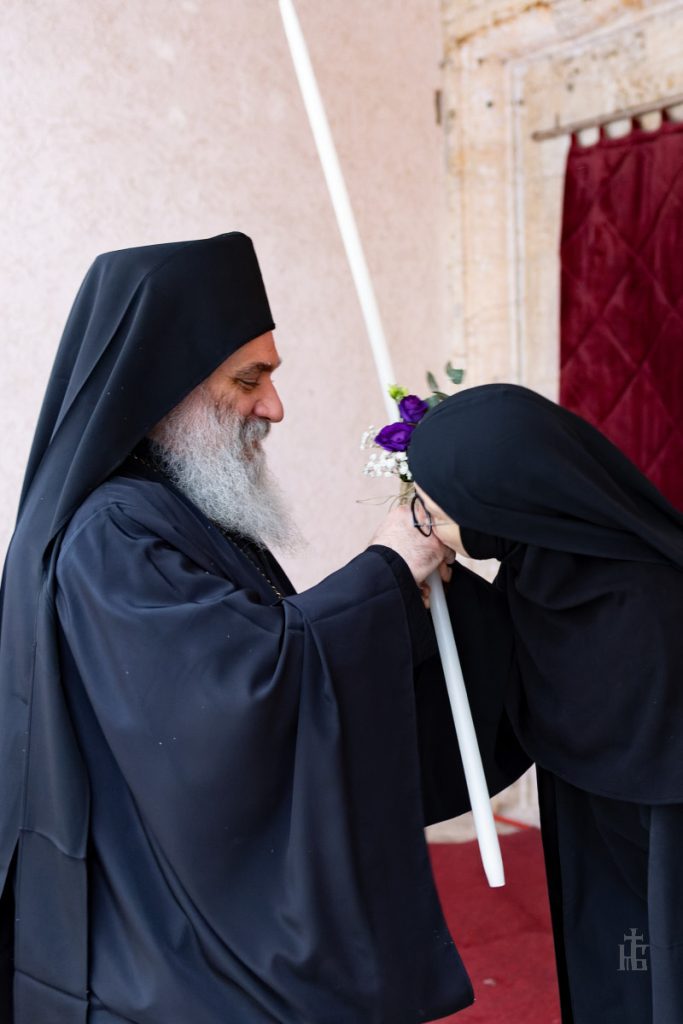
That sacred apostolic work was not merely theoretical. It required arduous labor to re-church a people who, after decades of spiritual darkness, needed once again to behold the light of the Liturgy. Today, when we see churches filled, people consciously approaching confession and Holy Communion, we see the fruits of that seed. This is living proof that the mission was not administrative, but essential. It laid the firm foundations upon which people today seek—and find—answers to their existential crises.
Question: Can Christmas be a new hope for the world? And how does the Church understand this?
Sister Ephimia: My message is simple, yet the most difficult to fulfill: to dare to seek Christ where we least expect Him.
Today, the world searches for technological and political systems to resolve its dilemmas, yet these often end in dead ends because they forget the living human person and the need for meaning. History has become a kind of tomb for failed concepts that sought to save the world through force, decrees, or exclusivity. But the Nativity of Christ offers a different answer. It reminds us that God is not an abstract idea at the top of some hierarchy, but a Person who entered into our pain. That is why Christ is needed by all of us—not as a religious symbol, but as oxygen for our society. He is the quiet light that does not blind us, but illumines our path toward the other—and toward Himself.
Without this divine vertical dimension, every horizontal project of social justice or ideological vision easily becomes fragile. Therefore, let us not seek Christ only in the glitter of festive lights and shopping streets, but in the silence of our own conscience and in the eyes of the one who suffers. For He seeks to be found—not by force, but through dialogue; through understanding, through listening. With His birth, He was the first to initiate this dialogue with us. Our task is to respond by becoming a little more kenotic—ready to empty ourselves of our anger and pride, so that we may embrace the other and embrace the world.
Only then will Christmas no longer be merely a day on the calendar, but a lasting condition of our heart. And when we have found Him, we will have already found all the answers.