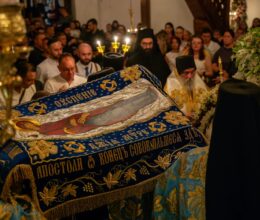
When, in the Friday twilight silence of the church at Bigorski Monastery, the final echo of penitential Clean Friday faded away, another hymn took its place – more solemn, fresher, filled with pure thanksgiving and filial trust. The brethren and the faithful stood upright with dignity, for this is precisely what the Akathist signifies: not sitting, but standing – upright not only in body, but with the whole soul raised toward Her to whom we sing with joy and gratitude.
Our beloved Elder, His Grace Bishop Parthenius of Antania, intoned the first stasis with deep compunction, like a son offering thanks to his mother – with a voice trembling in love, like a child who, after long absence, has at last found his mother’s embrace.
For the Akathist is precisely that: the embrace of the soul with the Mother of God, the overflowing of a heart that cannot but express its love. It is the first resting place in the holy Forty Days beneath her protective veil.
Everything begins with the triumphant proclamation of victory:
“To thee, the Champion Leader, we thy servants dedicate a feast of victory and of thanksgiving, as ones rescued out of sufferings, O Theotokos; but as thou hast invincible might, free us from every peril, that we may cry to thee: Rejoice, O Bride unwedded!”
Here the Theotokos is the Champion Leader – not distant and honorary, but real and near, she who leads us in the struggle of the Fast against invisible enemies. Freed from evils through her intercession, we cannot remain silent. Gratitude compels us to sing.
Then comes the Angel:
“The Archangel was sent from heaven to say to the Theotokos: Rejoice!”
The whole first stasis unfolds that first “Rejoice” and its endless echo through the centuries. The bodiless Archangel Gabriel approaches the Virgin, yet:
“Seeing Thee, O Lord, taking bodily form at his bodiless voice, he stood in awe and cried unto her thus…”
Even the Angel trembles. For what takes place surpasses angelic understanding: the Uncreated enters the created womb; the Infinite is contained within finite flesh; He who “bowed the heavens and came down” dwells wholly and unchangeably in her.
Thus the salutations follow like pearls:
“Rejoice, through whom joy shall shine forth! Rejoice, through whom the curse shall cease!”
Joy and curse – the two poles of human history – meet in the Virgin: she brings forth the first and abolishes the second. She is “Rejoice, recall of fallen Adam! Rejoice, redemption of the tears of Eve!”
In her, the tragedy of Paradise becomes doxology.
“Rejoice, height beyond the reach of human thought! Rejoice, depth beyond the sight of angels!”
Not even angels can fathom her mystery, and yet we sinners dare to sing to her. Such is the boldness that fasting grants: purified even a little, we may stand before her.
Then comes the Virgin’s answer – chaste and courageous:
“Strange is thy speech to my soul; how speakest thou of a birth without seed?”
She does not accept blindly, but asks. And in that question her purity is revealed: she seeks to know the unknowable mystery. The answer pours forth in a new cascade of salutations:
“Rejoice, initiate of the ineffable counsel! Rejoice, ladder by which God came down! Rejoice, bridge leading those on earth to heaven!”
Ladder and bridge – images dear to us as Lenten pilgrims. We too ascend a ladder – the ladder of fasting – and cross a bridge – the bridge of repentance. And she is both ladder and bridge.
When “The power of the Most High overshadowed her for conception,” her womb became “a fertile field for all who desire to reap salvation.”
A field! In the midst of Lent we hear of harvest. For Lent is sowing, and Pascha is harvest. The Seed was sown in the field of the Theotokos and in the field of our hearts; if we guard and cultivate it with patience, we shall reap salvation.
The fourth kontakion depicts the shepherds:
“The shepherds heard the angels singing hymns to Christ’s coming in the flesh, and seeing Him as a spotless Lamb pastured in Mary’s womb…”
A Lamb pastured in the womb – the Paschal Lamb whose Blood marked us on Clean Friday, the Lamb who at the end of the Forty Days will be slain on Golgotha and rise again.
“Rejoice, Mother of the Lamb and Shepherd!
Rejoice, fold of rational sheep!”
We, the rational sheep, are within her fold, and from that fold no one can snatch us.
When the Elder pronounced the final “Rejoice” of the first stasis and the choir concluded, “Rejoice, O Bride unwedded!”, a holy exaltation filled the church – the joy of hearts that know they are not alone on the Lenten path. The Mother is here. Her protection is over us. Four more Fridays await – second, third, fourth stasis, and finally the whole Akathist – and each will be a new step toward Holy Pascha, a new “Rejoice” amid the tears of repentance.
For the Akathist in Great Lent is joy in the midst of strictness. It is “Rejoice” in the midst of “Have mercy on me.” This is Orthodoxy: not either–or, but both–and. Both repentance and joy. Both Cross and Resurrection. Both tears and “Rejoice, O Bride unwedded.”