Friday. The end of the first week. And when this evening the sun sets behind Mount Bistra, we shall be able to say: we have passed through. With God’s help, with prayer, with intense struggle and patience. The first week of Great Lent – the strictest and most demanding – is behind us. Yet not behind us as something merely past, but within us, as a foundation upon which everything that follows will be built.
The hymnography of Clean Friday is filled with the Cross. From beginning to end, every troparion, every irmos, every sticheron bears the shadow and the light of Golgotha.
“By Thy divine Cross Thou hast mortified the passions of my flesh;
by Thy Passion Thou hast granted freedom from the passions unto all mankind.
Count me worthy also, O Lord, to behold Thy holy Resurrection.”
Here lies the whole mystery of Friday: it is the day of the Cross, yet the Cross always looks toward the Resurrection. There is no Golgotha without the empty tomb. There is no Friday without Sunday.
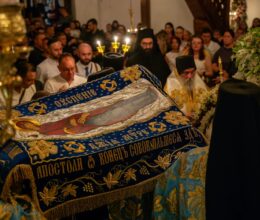
This Friday also brings its own gift: the second Liturgy of the Presanctified Gifts in this first week, the second Communion following the three-day—and now five-day—fasting of the brethren and the faithful. Once more, the church was filled with souls thirsting for the Chalice of Life, confirming that the ascetical struggle of this week was not in vain.
Yet the hymnography of this day allows no self-satisfaction. It awakens us—literally:
“I have fallen into the heavy sleep of sin through heedlessness; but, O my Christ, Thou who for my sake didst fall asleep upon the Cross, awaken me, lest the night of death overtake me.”
What an image: Christ “slept” upon the Cross—that is, He died—in order to awaken us from the sleep of sin. His death is our awakening. His falling asleep is our dawn. Thus the katavasia of the fifth ode proclaims:
“The night is far spent; the day is at hand! Thy light has shone upon the world!”
This is not merely a hymn; it is the confession of the entire first Lenten week: the night of the passions is far spent, and the day of grace draws near.
And amid all this cruciform strictness, the Canon reveals an image of inexpressible beauty:
“Crowned with thorns and clothed in purple, O Christ, Thou hast shone forth in glory, surpassing in beauty all the sons of men.”
This is the mystery of the Cross: though most humbled, Christ is most beautiful. Though dishonored, He radiates splendor. And if we accept the logic of the Cross—that strength is perfected in weakness, that glory lies in humility—then even our modest fast, our small ascetical offering, becomes beautiful and well-pleasing before God.
The stichera of Matins call us to something concrete, bodily, and yet profoundly spiritual:
“Let us receive the proclamation of the Fast with joy! For had our forefather Adam honored the Fast, we would not have been deprived of Paradise. The fruit that slew us was fair to behold and good for food; let us not be deceived by our eyes, for once eaten, food is worthless.”
How sober this thought is! Everything that tempts us is “pleasing to the eye,” yet once swallowed it becomes nothing. The only food that abides eternally is Christ the Savior. The only fruit that does not pass away is the fruit of repentance.
The same sticheron ends with a Paschal note:
“Let us be marked with the Blood of Him who was willingly led to death for our sake, that the destroyer may not touch us; and thus we shall partake of the holy Pascha of Christ for the salvation of our souls.”
The Blood of the Lamb—as once in Egypt upon the doorposts, so now upon our lips in Holy Communion—guards us from the angel of death. The entire Fast is preparation for that tasting, for that Pascha.
The Vespers of this Friday also commemorate Saint Theodore the Recruit, the holy warrior who, even after death, cared for the faithful. When the apostate Julian sought to defile the fasting Christians by polluting their food, Saint Theodore appeared to the archbishop in a dream and warned him, saving the people from impurity.
“The devil used the apostate as a vessel of evil,” the sticheron says, “filling him with unclean thoughts to defile the food of a fasting people. But thou didst outwit his malice: Тhou didst appear to the archbishop in a dream and reveal the wicked plot.”
Thus the Church each year blesses the kolyva – boiled wheat – as a sign that God always cares for His people, even when the enemy imagines he has prevailed.
And so the first week ends. Not with fanfare, not with worldly pleasures, but with quiet gratitude and joy in the heart. We have traversed the path. The Cross has borne us. The night is far spent, and the day – the day of the Resurrection – is ever nearer. Tomorrow the Church will celebrate the miracle of the kolyva and lead us into the first Sunday of Holy Lent—the Sunday of Orthodoxy. And we, marked with the Blood of the Lamb, continue toward Pascha, with contrite hearts and eyes filled with light.