We experience the memory and presence of Christ’s saints as a heavenly visitation, as a grace-filled touch of eternity upon our transient life. But Saint John the Baptist… For Bigorski, he is something even more! He is not merely the saint to whom the Monastery is dedicated, nor merely the heavenly intercessor of this ancient holy place. He is our eternal Master of the house, our gracious Host, our merciful father and protector—the one beneath whose gaze, for more than a millennium, this sanctuary has lived, suffered, risen again, and offered its prayers to God.
Great indeed is the honour of having such a Host. Great—but also demanding.
For whoever dwells in the house of the Forerunner is called, day and night, to listen to his voice: first to make straight the ways of the Lord within his own heart; to live in repentance, in truth, in freedom from the vanity of the world, and in an unceasing striving towards Christ. Saint John transformed his entire life into one single pointing towards the Lord—to decrease himself, that Christ might increase; to disappear from the sight of men, that before them there might remain only the Lamb of God.
This is precisely why every feast of his at Bigorski is something far more than an annual celebration. It is an encounter with the Master of the house. It is a return to the source of our monastic identity and to the calling for which this Monastery exists.
With this awareness, with filial gratitude, and with that reverent zeal which allows nothing to be accidental or superficial, our beloved Elder and Abbot, His Grace Bishop Partenij of Antania, once again this year took fatherly care that the feast of our heavenly protector should be adorned with every possible beauty and solemnity—not for the sake of outward splendour, but so that everything visible might become an expression of inward gratitude to the Honourable Forerunner. The church, the divine services, the chanting, the hospitality, every meticulous labour of the brotherhood—all had one single purpose: to offer the very best to him who for so many centuries has guarded his Bigorski home.
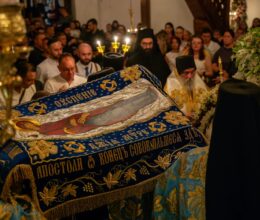
From the early hours, streams of people began flowing towards the Monastery. From every part of our homeland, but also from neighbouring Albania, Bulgaria, Greece, and Serbia, faithful and pilgrims arrived—whole families, young and old—to stand before the wonderworking icon of the Forerunner, to venerate his holy relics, and to lay before him their gratitude, their sorrow, their prayer, and their hope.
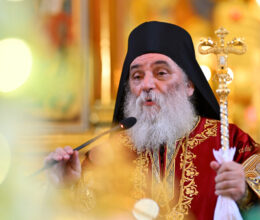
In the afternoon, the Monastery bells solemnly announced the arrival of our esteemed hierarch, His Eminence Metropolitan Georgij of Debar and Kičevo, who was received with honour and reverence at the Monastery gates by our Elder, the brotherhood, the clergy, and the faithful people.
And soon, the sacred night began.
The festal Vigil was prayerfully presided over by our esteemed hierarch, His Eminence Metropolitan Georgij of Debar and Kičevo, while in the venerable liturgical assembly—besides the clergy of Bigorski—there also took part Protopresbyters Aleksandar Dimoski from Struga and Goran Stavreski from Ohrid, Presbyters Pavel Krcoski from Ohrid, Hristijan Kostoski from Struga, and Mile Angelkoski from Debar, Hieromonks Theodosij and Ignatij from the Monastery of Saint Elijah in Čardak, Skopje, as well as Protodeacon Nikolče Gjurchinoski from Ohrid. The service itself was led with sacred dignity and devotion by our brother, Archimandrite Dositej, for whom this holy evening bore a special personal seal: precisely then, thirty years were fulfilled since the beginning of his monastic struggle.
The Vigil gradually drew the mind away from all earthly things. As the hours passed, time itself seemed to lose its usual measure. The hours were no longer counted, but rather the psalms, the stichera, the prayers, and the thanksgivings; weariness was no longer felt, but instead that strange and serene joy which is born when a person remains for a long while before the face of God and forgets himself.
A particular adornment of the festal Vigil was the presence of the splendid choir of Eastern Orthodox chant “Saint John Koukouzelis” from Tirana, who came with the blessing of His Beatitude John, Archbishop of Tirana, Durrës, and All Albania. Together with the choir of the Bigorski brotherhood, our dear guests not only filled the church of the Forerunner with dignified and prayerful Byzantine psalmody, but seemed to bestow upon the entire Vigil a special heaven-and-earth tenderness and a solemn radiance. Their voices, nurtured in the ancient tradition of Eastern church music, rose humbly, profoundly, and beautifully, like a fragrant offering of incense before the throne of God, bringing into the hearts of those present compunction, gratitude, and the sense that Orthodox prayer, when offered with purity and love, transcends all boundaries and all languages.
And indeed, there was something especially moving about that night: hymns to one and the same saint, before one and the same Holy Altar, from one and the same Orthodox heart, were raised in Macedonian, Church Slavonic, and Albanian. Different languages, yet one faith; different voices, yet one doxology; different peoples, yet one Church. And Saint John, who once by the Jordan called all the people to one repentance and to one Christ, seemed once again to gather everyone around himself—not according to blood or language, but according to faith and love for the Lord.
Yet the greatest joy of this festal night was still to come.
After the Evening Entrance and the compunctionate chanting of the ancient hymn “O Gladsome Light,” the church seemed to fill with a different kind of silence—a silence of expectation, of trembling, of something belonging not merely to the earth and to the present moment.
And while the choir tenderly poured forth before God that well-known sticheron from the Sunday of the Prodigal Son—the same penitential hymn chanted also at the monastic tonsure:
“Make haste to open unto me Thy fatherly embrace; I have spent my whole life in prodigality. Looking toward the inexhaustible wealth of Thy mercy, despise not now my impoverished heart; for unto Thee, O Lord, I cry with compunction: I have sinned against Heaven and before Thee.”
—our Elder, with that deeply solemn and sacred countenance of his, through tears of thanksgiving led his three new monastic children towards the Altar of the Lord. In that moment, all paths seemed to converge: the penitent return of the son to the Father, the monastic surrender of the soul to Christ, and the fatherly love of the spiritual father, who was leading them not merely as far as the Royal Doors, but presenting them as a living offering before the mercy of God.
Before God, before the Mother of God, before Saint John, before the hierarch, before the Elder, the brotherhood, and the multitude of faithful, there stood those who until that moment had been our brothers Stefan, Vladimir, and Jovan.
Three Christ-yearning souls who had not arrived at that moment suddenly. Behind them stood years of life in the Monastery; days and nights of obedience; falls and risings; labour, prayer, struggle with oneself; countless small renunciations of their own will which the world will never notice, yet out of which a monk is truly fashioned.
And on this sacred night they uttered their decisive “yes” to Christ’s call, receiving from the hands of Metropolitan Georgij the holy and angelic tonsure.
They left behind the names they had borne until then and, as a sign of their new spiritual birth and a new beginning in Christ, received their monastic names: Stefan became Theodosius, Vladimir—Chariton, and Jovan—Nikephoros.
Three new names were inscribed into the centuries-old monastic diptychs of Bigorski. Yet these names were not chosen by chance. Theodosius and Chariton received the memory of the great Palestinian Fathers and founders of monasteries—Saint Theodosius the Great and Saint Chariton the Confessor—those luminaries of the desert through whom, in ages past, the Holy Land was filled with ascetic striving, prayer, and angel-like monastic life.
And yet, for Bigorski these names are not merely a distant remembrance of ancient Palestine, but also a familiar, fraternal echo from its own history: here too, in this holy Monastery, there were once monks who bore these blessed names. The name Nikephoros, in turn, bears the memory of Saint Nikephoros, Patriarch of Constantinople, a great defender of the Orthodox Faith and a mighty intercessor before God; yet this name too had once already been written into Bigorski’s monastic memory.
Thus the Elder, with that quiet and profound spiritual discernment of his, desired that this time the new names should signify not merely a new beginning, but also a continuation—as though from the old Bigorski diptychs the voices of monks from former times had awakened once again, to become heavenly companions to the newly born brothers.
Three human lives were offered to God. Three new lamps were kindled before the icon of the Forerunner.
And monasticism, in truth, is precisely this: for a person to allow God to take his entire life. It is not flight from the world because the world is despised, but withdrawal so that the whole world may be embraced even more deeply in prayer. It is not rejection of man, but the freeing of the heart from everything that prevents it from truly loving. It is not contempt for life, but longing for its fullness.
The monk closes behind himself the door to many possibilities in order to open one alone—the door leading to complete surrender to Christ. He becomes a man of expectation. A man whose entire life proclaims that this world, however beautiful it may be, is not man’s final homeland; that there is a Bridegroom for Whom the soul waits; that there is a Kingdom which has already begun, but is yet to be revealed in its fullness.
And could there have been a more natural place for such a birth than the house of Saint John?
He who lived in the wilderness, who possessed nothing of his own, who was free from human praise, from fear and compromise, who became wholly a voice proclaiming Christ—he is one of the brightest prototypes of the monastic soul. Therefore, for centuries the Holy Forerunner has been not only the patron of the Monastery, but also the teacher of its monks.
And behind every true monastic birth there also stands another mystery: the mystery of spiritual fatherhood.
The new monks were not born by themselves. Their path was borne within the heart of their Elder—with the love of both mother and father, with prayer, with patience, with rebuke when it was needed, with consolation when their strength grew weak, with silence when words would have been too much, with unceasing vigilance and care, so that Christ might be formed within them.
For in a monastic community the Elder is not simply an administrator, nor merely an experienced counsellor. He is a father in the deepest spiritual meaning of the word: one who receives a soul as it is and carries it within himself until, through the grace of God, that soul begins to recognise its true countenance in Christ.
Such a father to his monastic children is our Elder, Bishop Partenij—a father of fathers, who for more than three decades has been begetting and forming souls for the monastic life and who, through his own self-offering, shows that spiritual fatherhood is not authority but crucifixion; not privilege, but the unceasing carrying of the other within one’s heart.
Therefore, when the three new monks stood in their new monastic riassa and schemas before the Baptist of the Lord, the Elder’s joy was the joy of a father beholding his children take their free and mature step towards Christ. And the joy of the brotherhood was the joy of a family suddenly made richer by three newly born brothers.
Theodosius, Chariton, and Nikephoros.
May your new birth in Christ be blessed, our beloved brothers!
May the monastic habit never become for you merely a garment, but an unceasing reminder of the vow of your heart. May obedience become your freedom, humility your strength, prayer your breathing, and the brother beside you your path towards Christ. Guard the blessing of your Elder as your most precious inheritance, and in his fatherly love recognise the call of Him for Whose sake you have left all things behind.
And thou, O holy and glorious Prophet, Forerunner and Baptist of the Lord, John, our most beloved protector and Master of this holy place, look mercifully upon thy new monastic children. Shelter them in temptations, strengthen them in the ascetic struggle, teach them thy freedom from the world, thy zeal for the truth, and thy humility before Christ.
Guard our Elder, guard his monastic family, guard this thy ancient Monastery and all the faithful people who flee unto thee with love. And as once thou didst prepare the way of the Lord in the wilderness, so prepare also our hearts, that Christ may find within them a place in which to dwell.
O Saint John, forsake not thy Bigorski home and thy children, but be our intercessor, guide, and supplicant before Christ our God, until the new heaven and the new earth. Amen.